
How Invasive Is Wisteria?


A little green. A lot of curiosity.
Wisteria is one of those vines that can make you fall in love in spring, then make you quietly reconsider your choices by midsummer. When people ask, “How invasive is wisteria?” they are usually asking a few very practical things: Will it spread into my yard, my neighbor’s yard, or the woods? Will it break my fence or climb into my attic? And if I plant it anyway, can I keep it contained?
Let’s talk roots, runners, and the difference between the famously aggressive Asian wisterias and the better behaved North American options.

Quick answer: which wisteria is invasive?
In most of the US, the plants most often called “invasive wisteria” are the Asian species:
- Chinese wisteria (Wisteria sinensis)
- Japanese wisteria (Wisteria floribunda)
These can spread aggressively, escape cultivation, and smother trees and shrubs. They are listed as invasive by many state invasive plant councils, especially across parts of the eastern and southeastern US. Rules vary by state and locality, so “regulated” depends on where you live.
Also worth knowing: there are other Asian wisterias and cultivars in the nursery trade. Silky wisteria (Wisteria brachybotrys) is less commonly planted, but it does show up in invasive-plant discussions in some regions.
The native alternatives are typically much lower risk:
- American wisteria (Wisteria frutescens)
- Kentucky wisteria (Wisteria macrostachya)
“Lower risk” does not mean “tiny and polite.” Even native wisterias are strong, woody vines that need a sturdy support and regular pruning. But they are generally less likely to rampage through a landscape and into nearby natural areas.
Why Asian wisteria spreads so well
Chinese and Japanese wisteria have a few traits that make them champion spreaders:
- Fast, forceful twining growth. They wrap tightly around supports and keep thickening into heavy, woody ropes.
- Vegetative spread. They can send up new shoots from their root system and from stems that touch soil.
- Seed production. Mature vines produce pods with viable seed. Seedlings may pop up where you least expect them.
- High tolerance. Once established, they handle a range of conditions and can be hard to kill with “light” control efforts.
In a garden, that translates to constant opportunities for the vine to claim new territory if it is not actively trained, pruned, and checked at ground level.
Ecologically, the big issue is what happens when wisteria reaches unmanaged edges. It can climb into shrubs and trees, shade them out, and add weight that increases breakage risk during storms.
How to tell what you have
If you inherited a mystery vine, don’t guess based on flower color alone. The most reliable options are still the simplest:
- Check the plant tag or receipt if you have it.
- Ask the nursery where it was purchased. Reputable sellers can often confirm the species or cultivar.
- Use local ID help through your state extension office, a local Master Gardener program, or a regional invasive plant council.
If identification matters because you are near woods or natural areas, it is worth getting a confident ID before you let the vine mature and set seed.
How far do wisteria roots spread?
Wisteria develops a substantial root system that anchors the plant and fuels its vigorous top growth. The exact spread depends on the vine’s age, soil, moisture, and what it is competing with. From a planning standpoint, here is what to assume:
- Roots can extend beyond the drip line. On established plants, roots commonly reach outside the canopy footprint to forage for water and nutrients. The distance is variable, so it is best to plan for “wider than you expect,” not a neat circle.
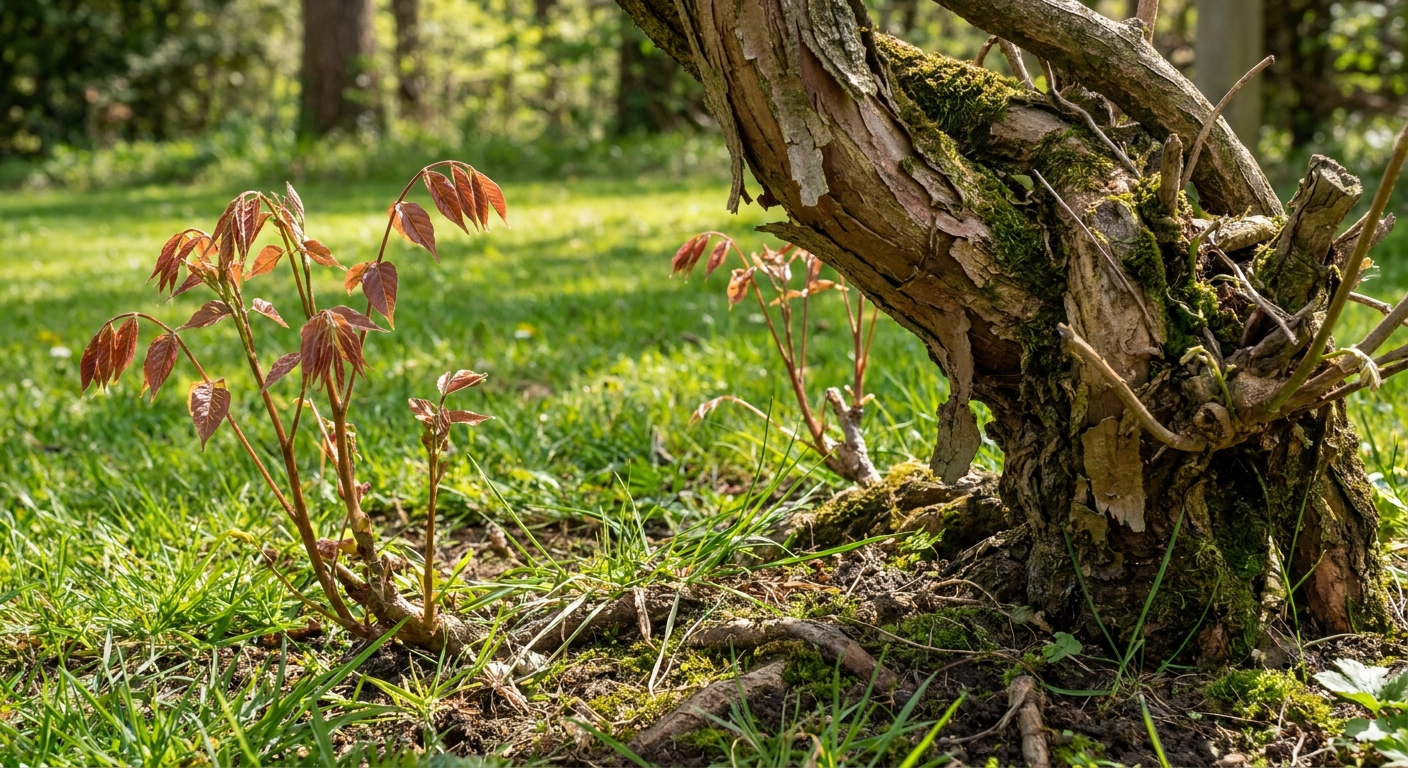
- New shoots can emerge at a distance. What many gardeners call “runners” are often suckers or new sprouts arising from the root system. These can show up several feet away from the main trunk, and older vines may surprise you farther out.
- Disturbance can trigger more sprouting. Cutting, digging, or damaging roots can encourage the plant to respond with new shoots, especially in aggressive Asian types.
If you are deciding where to plant wisteria, assume it will not stay neatly “right where you put it.” Give it room, and give yourself room to patrol for shoots.
Does wisteria spread by runners?
Gardeners use “runner” loosely here. Wisteria can “spread” in three common ways, and they can all feel like runners when you are the one finding them:
- Root suckers: shoots that emerge from the root system. These are the classic surprise sprouts in nearby beds or lawn.
- Layering: long stems that touch the ground can root where they make good contact with soil, forming a new plant.
- Seed: pods mature and scatter seed. Seed spread is more variable, but it matters most near natural areas where seedlings can establish unnoticed.
Asian wisterias can use all three routes effectively. Native wisterias can do some of this too, just typically with less intensity and less frequent “takeover” behavior.
Can wisteria damage structures?
Yes, wisteria can absolutely damage structures, not because it has magical demolition powers, but because it combines weight, tight twining, and relentless growth.
Common structural problems
- Crushed or bent trellises and arbors. Lightweight lattice and thin metal supports can fold under the mass of mature growth.
- Warped fences. Wisteria can pull sections out of alignment or pry apart boards as stems thicken.
- Gutter and roofline trouble. Vines can climb into eaves, wrap around downspouts, and trap moisture and debris.
- Suffocated plants and trees. In landscapes and wild areas, the vine can climb and shade out trees, adding weight and increasing wind load.
What about foundations and pipes?
Wisteria roots are not usually described as the kind that crack a sound foundation the way some large trees can. The bigger risk is where the vine is allowed to climb and what it wraps around. Like many woody plants, wisteria roots can exploit existing cracks and weak points in old masonry, hardscape, or aging drain lines, rather than creating brand new damage in solid concrete.
If your home has older masonry, questionable gutters, or a fence you love exactly as it is, wisteria should be planted far enough away that you can keep it on its support and off everything else.

Where not to plant wisteria
If you want wisteria without regret, location does most of the heavy lifting.
Avoid these spots
- Near forests, parks, or unmanaged edges. This is where escapes become ecological problems. Even a beautiful vine in a yard can become someone else’s nightmare down the slope.
- Right against the house. Vines and siding, vines and gutters, and vines and rooflines are a trio that rarely ends calmly.
- On weak structures. If a trellis is easy to lift with one hand, it is not ready for wisteria long term.
- Over small ornamental trees. Wisteria will treat them like a ladder and can overwhelm the canopy.
- Next to property lines you cannot monitor. If you cannot access both sides for pruning and sucker removal, pick a different plant.
Better placements
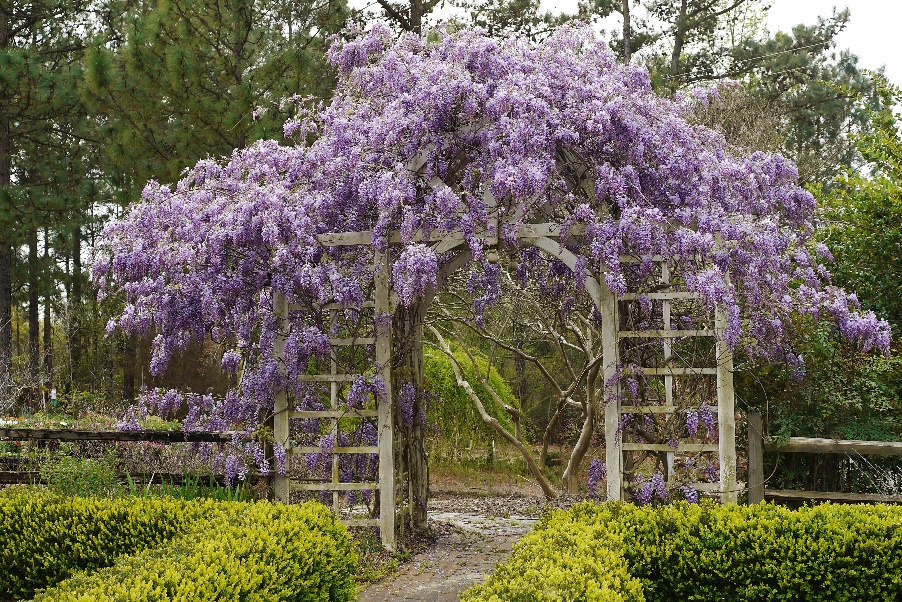
- A freestanding, heavy-duty arbor set well away from buildings.
- A strong pergola built with the expectation of serious load.
- A dedicated support with open ground around it so you can spot and remove suckers.
American vs. Kentucky vs. Asian wisteria
These are the big picture differences that matter when you are choosing a plant with containment in mind.
Asian wisteria (Chinese and Japanese)
- Most aggressive growth and greatest escape risk in many regions.
- Heavier, faster canopy that can overwhelm supports and climb into trees.
- Often flowers before leaf-out and can be spectacular, which is part of the trap.
American wisteria (Wisteria frutescens)
- Native in parts of the eastern and southeastern US.
- Generally less aggressive and less likely to smother nearby trees when managed.
- Often blooms a bit later and may be less prone to “all vine, no flowers” behavior when properly sited and pruned, though care still matters.
Kentucky wisteria (Wisteria macrostachya)
- Also North American and commonly recommended as a native alternative.
- Still vigorous, but typically a safer pick than Asian species in landscapes where invasiveness is a concern.
- Known for cultivars bred for reliable bloom in some regions.
One important nuance: invasiveness is regional. A plant can behave acceptably in one climate and become a menace in another. If your state extension office or local invasive plant council flags Asian wisteria as invasive, take that seriously and choose a native species or a different vine.
How to keep wisteria contained
If you already have wisteria or you are committed to growing it, containment is possible, but it is not “plant it and forget it.” Think of it as a long-term training relationship.
1) Start with the right plant
- Prefer American or Kentucky wisteria if invasiveness is a concern where you live.
- Avoid unknown seedlings and mystery vines dug from old homesteads. Those are often Asian wisteria and may be extra unruly.
2) Give it a single, sturdy support
- Use a structure built for weight: thick posts, strong beams, solid anchors.
- Plan for access so you can prune all sides.
3) Prune on purpose, not just for looks
Pruning is not only for blooms. It is also containment. Regular pruning reduces the vine’s ability to reach new surfaces, layer into the soil, and build a huge woody framework that is hard to correct later.
If you want one simple rhythm many gardeners use: a summer prune to shorten wild shoots and a winter prune to tighten the framework. Timing varies by region and by how your plant grows, but the concept is consistent: cut it back, then cut it back again.
- Remove long wandering shoots promptly. If it is reaching for the roof, it is already too close.
- Cut out growth that heads into shrubs and trees. Do not let it “borrow” a living trellis.
4) Patrol the ground for suckers
Walk the area around the plant during the growing season.
- Pull tiny shoots when the soil is moist, if they detach cleanly.
- For tougher shoots, cut them below soil level and repeat as needed. Persistence matters more than drama.
- Keep the base area open so you can see what is happening.
5) Be careful with compost and yard waste
- Do not dump cuttings in a back corner where they can root.
- Dispose of pods and viable seed thoughtfully, especially if you are near natural areas.
If wisteria has escaped: control options
Escaped wisteria can be controlled, but it is usually a multi-season project. Expect regrowth and plan follow-up.
Step 1: Stop it from climbing and seeding
- Cut vines off trees and shrubs to prevent further smothering.
- Remove seed pods when you see them so you are not fighting seedlings too.
Step 2: Cut back to the base
For thick, woody stems, loppers or a pruning saw are often necessary. Cut vines near the ground and remove what you can safely pull down.
Step 3: Dig where practical
Small plants can sometimes be dug out, but wisteria can resprout from root fragments. Digging works best when you can remove a substantial portion of the root crown and follow up quickly on resprouts.
Step 4: Consider targeted herbicide for established infestations
In many areas, the most reliable control for large, mature wisteria involves a cut-stump treatment or similar targeted approach using an appropriate systemic herbicide, applied according to the label. This avoids blanket spraying and can reduce regrowth.
If you go this route, follow local regulations, protect desirable plants, and consider contacting a local extension office for region-specific timing and product guidance.
FAQ
Is wisteria invasive everywhere?
No. Invasiveness depends on species and region. Asian wisteria is widely problematic in many parts of the US, while American and Kentucky wisteria are generally better choices where native options are appropriate.
Will wisteria come back if I cut it to the ground?
Often, yes. Wisteria is a strong resprouter. Cutting is a good first step, but expect regrowth and plan repeated removal or additional control methods.
Can I grow wisteria in a container to keep it from spreading?
You can start a young plant in a container, but long-term container culture is challenging because wisteria wants to become a large woody vine. A pot also does not solve the biggest issue if the vine is allowed to sprawl and touch the ground, where it can root. If you try it, use a very large container, a sturdy support, and keep stems from contacting nearby soil.
What is the safest “wisteria look” alternative?
If Asian wisteria is invasive where you live, the safest wisteria look is usually American or Kentucky wisteria sourced from a reputable nursery and trained carefully on a sturdy structure. If you need a different vine entirely, look for locally recommended native flowering vines through your state extension resources.
The calm path forward
Wisteria is not automatically a villain, but it is never a lightweight choice. If you want the flowers without the fallout, start by choosing the right species, give it a structure that can handle its ambition, and treat pruning and sucker patrol as regular garden chores.
Your future self will thank you, preferably while standing under an arbor that is still upright.