
When To Trim Wisteria

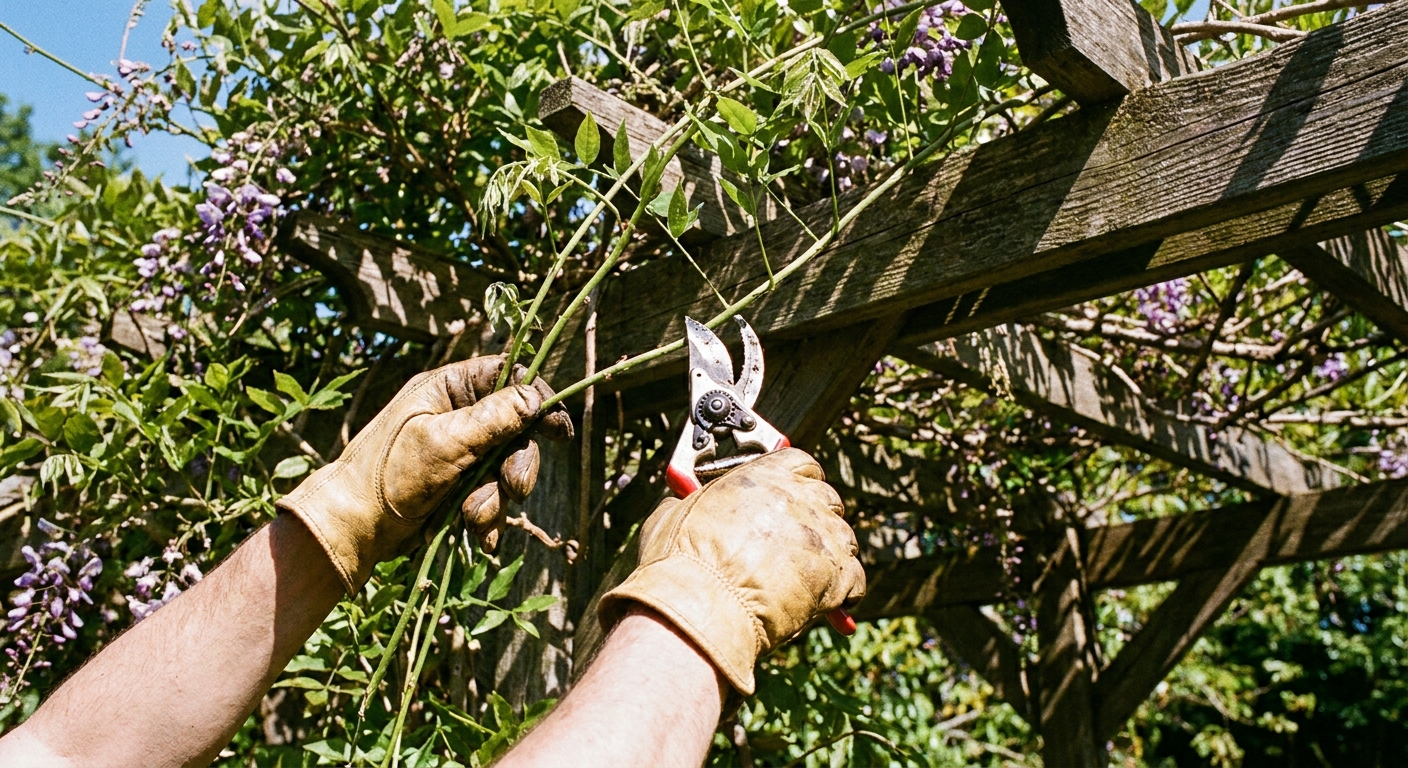
Wisteria is the friend who shows up with a gorgeous bouquet and then redecorates your entire house. Give it the right trims at the right times, though, and it becomes a well-behaved, bloom-covered dream instead of a vine that tries to eat your gutters.
The simplest answer is this: trim wisteria twice a year. Do a summer prune to rein in the wild whips, and a winter prune to focus the plant’s energy into flower buds instead of endless green growth.
Quick but important detail: not all wisterias bloom on the same type of wood. Chinese and Japanese wisteria bloom mostly on old wood (last year’s growth), while American wisteria blooms on new wood (this season’s growth). That one distinction changes how risky spring pruning is and how essential spur pruning is for flowers.

The best time to trim wisteria
Most wisteria responds best to a two-step routine.
- Summer trim: mid to late summer, after flowering and once the new growth has gone long and whippy. In many gardens this lands around July to August.
- Winter trim: late winter, while the plant is dormant but before spring growth really kicks in. Think January to February in mild climates, or February to March where winters are colder.
This pairing works because summer pruning reduces the plant’s tendency to pour energy into long runners, while winter pruning concentrates the structure and keeps spur growth (where many flower buds form) close to the main framework.
American wisteria note: this schedule still works beautifully for size control and structure. It just is not as strict for blooming, since American wisteria can flower on current-season growth.
Why wisteria needs two prunes
Wisteria can be generous with flowers or generous with chaos. Which one you get often comes down to where it forms flower buds.
- Chinese and Japanese wisteria (W. sinensis, W. floribunda): bloom primarily on old wood and on short spurs along older framework. Left alone, they produce vigorous shoots that shade those spurs and push the plant into “all leaves, no flowers” mode.
- American wisteria (W. frutescens, W. macrostachya): blooms on new wood (current season’s growth). It can still get rangy, but pruning timing is a little more forgiving for flowers.
A good schedule does three things:
- Improves bloom: more energy goes into flower buds instead of vine length.
- Keeps it safe: wisteria can pull on trellises, creep under siding, and wrap around railings if it is not redirected.
- Makes it manageable: you can actually see the structure and enjoy the blooms instead of wrestling a green octopus.
How to do the summer trim
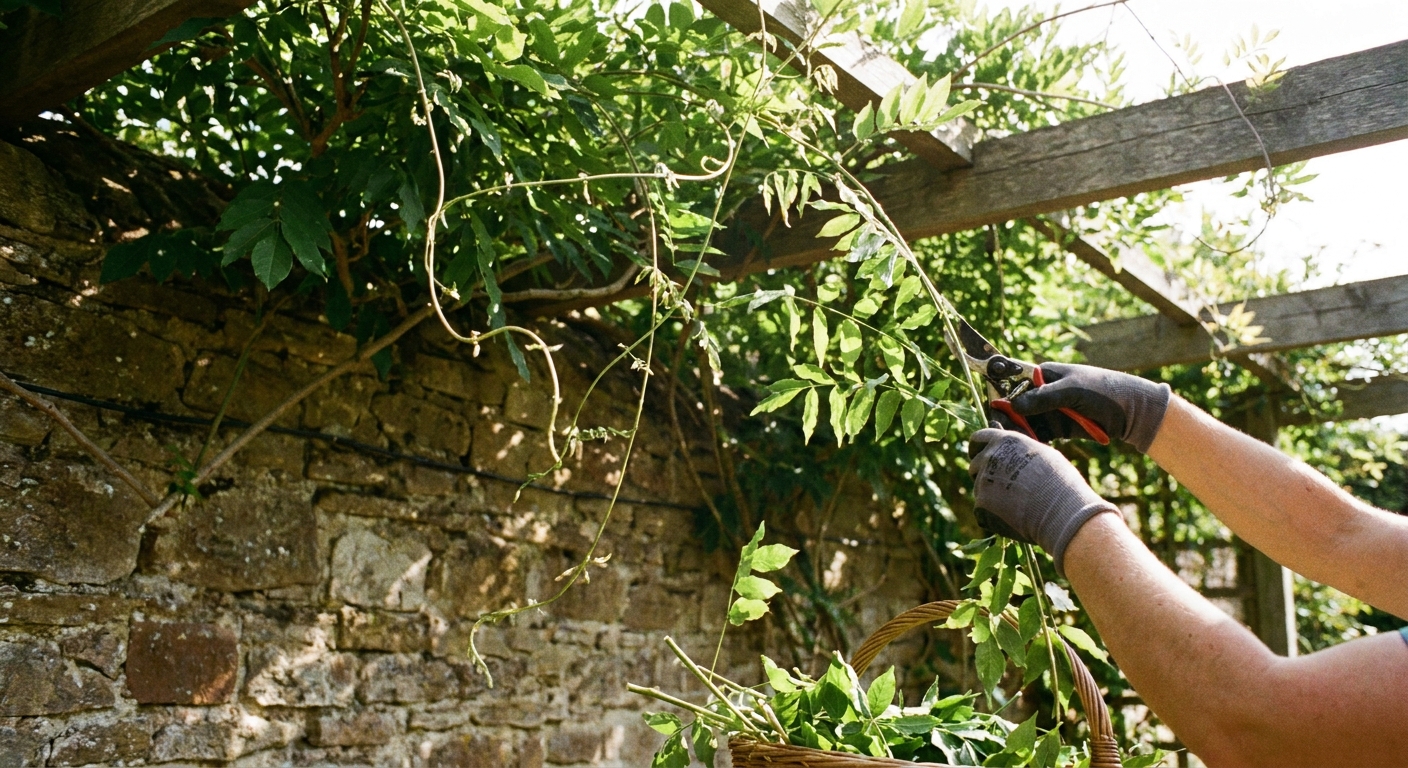
Summer pruning is the “calm down” haircut. You are shortening the long new shoots that exploded after flowering.
Step by step
- Wait until after the main bloom flush. Once the flowers fade and you see long green whips taking off, you are in the right window.
- Find this year’s long shoots. They are flexible, green, and often several feet long.
- Cut them back to 5 or 6 leaves. That is usually about 10 to 15 inches from where the shoot started.
- Remove problem growth. Cut out shoots heading into gutters, under shingles, through railings, or across windows.
- Tie in what you want to keep. If a new shoot is perfectly placed to extend the main framework, keep it and train it along your support rather than cutting it short.
Clara tip: If you are nervous, start by shortening only the most outrageous runners. You can always come back a week later and do a little more. Wisteria forgives, and your confidence grows fast.
How to do the winter trim
Winter pruning is the “set the stage for spring” trim. With leaves gone, you can finally see what is going on.
Step by step
- Prune in late winter. Aim for a dry day when hard freezes are not imminent.
- Locate the shoots you shortened in summer. They will be the stubby side shoots along the framework.
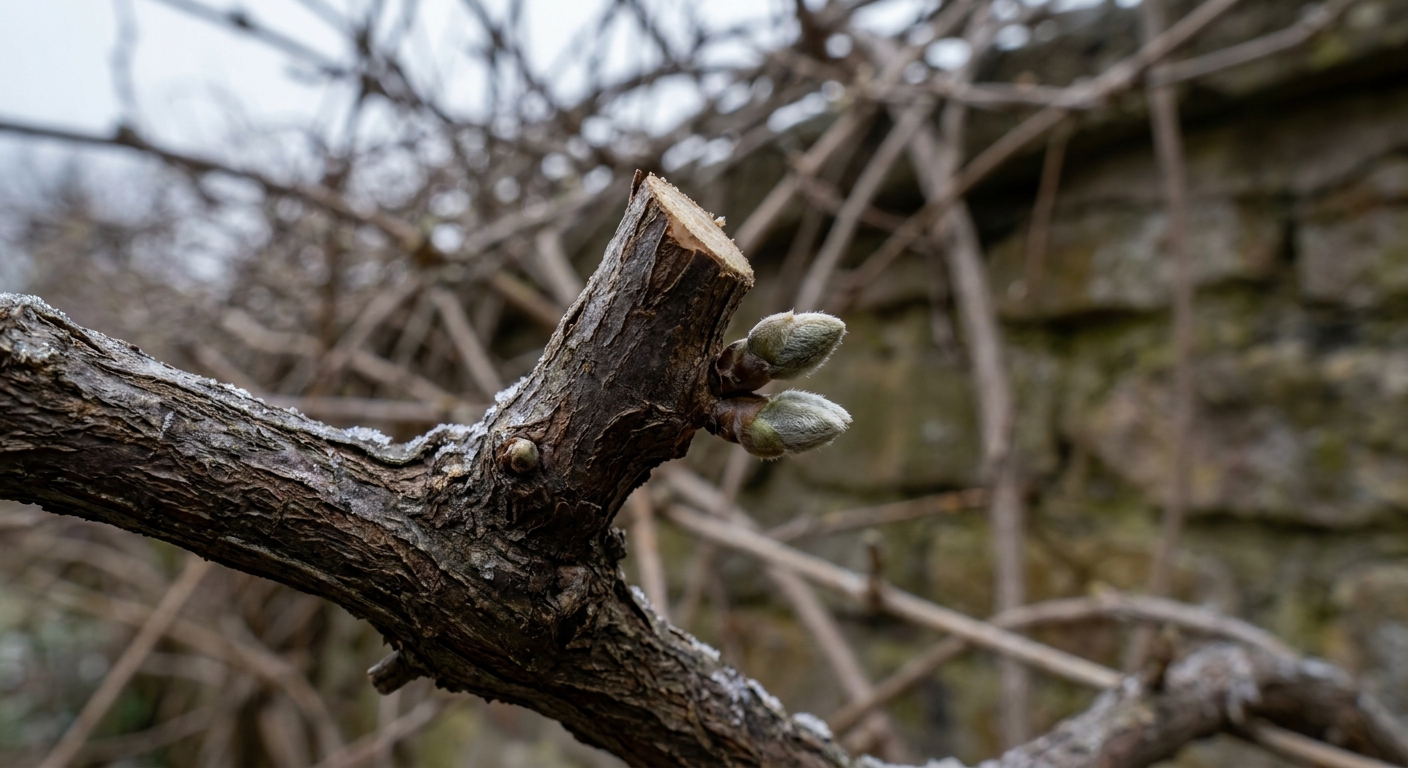
- Cut each one back to 2 or 3 buds. This usually leaves 2 to 4 inches of growth. These short spurs are where flowers develop on Asian types, and they also help keep any wisteria tidy.
- Thin crowded spurs. If a section is packed, remove some spurs entirely so light and air can reach the rest.
- Remove dead, damaged, or rubbing wood. Clean cuts help the plant heal smoothly.
What those buds look like: wisteria buds are little bumps along the stem. If you can leave a couple of plump buds close to the base of each side shoot, you are doing it right.
American vs. Asian timing
Most home gardeners can use the same twice-a-year rhythm for any wisteria. The difference is what that rhythm is accomplishing.
American wisteria (Wisteria frutescens, W. macrostachya)
- Blooms on new wood. That means a light to moderate early spring prune is usually fine if you need to shape it, because it can still flower on the new growth that follows.
- Less aggressive and often easier to keep in bounds.
- Still benefits from summer shortening and late winter structure work to prevent it from turning into a tangle.
- In some climates it blooms a bit later, so your “after flowering” window may shift by a few weeks.
Chinese and Japanese wisteria (Wisteria sinensis, W. floribunda)
- Bloom mostly on old wood. This is why the classic “summer cut to leaves, winter cut to buds” spur method is so effective.
- Very vigorous and more likely to produce long runners that need multiple check-ins.
- Do the regular summer prune, and feel free to do a light touch-up later in summer if it sends another wave of whips.
- Be especially strict about keeping vines off structures they can damage, like gutters and porch columns.
If you are not sure which you have: American wisteria is often sold as a more garden-friendly choice and tends to have a slightly less “take over the world” vibe. If yours flowers later (often early summer) and behaves a bit better, it may be American. If it blooms heavily in spring and grows like it has a personal grudge against your pergola, it may be Asian.
When not to trim wisteria
Timing mistakes are one of the biggest reasons people get lots of leaves and few flowers. The “do not” list depends a little on what type you grow.
- Do not hard prune Asian wisteria in early spring right before it blooms. You can accidentally remove the flowering spurs that were about to put on a show.
- American wisteria is more forgiving in spring, since it can bloom on new growth, but avoid extreme cuts right as growth is starting if you can. It tends to respond with a lot of vine and less of the neat framework you want.
- Avoid heavy pruning in fall in cold climates. It can encourage tender new growth that gets zapped by frost.
- Do not shear it like a hedge. Random cuts create tangles and more vigorous regrowth, which is the opposite of what you want.
What to do if it will not bloom
If your wisteria is healthy but stingy with flowers, pruning is only one piece of the puzzle. Here are the most common culprits I see in real gardens.
1) Too much nitrogen
Lush leaves, no flowers often means it is getting a lot of nitrogen, sometimes from a nearby lawn fertilizer. Skip high-nitrogen feeds. If you fertilize at all, choose something lower in nitrogen and higher in phosphorus and potassium, and use it sparingly.
2) Not enough sun
Wisteria wants full sun for best bloom. It can live in partial shade, but it may sulk.
3) It is still young, or grown from seed
Seed-grown wisteria can take many years to flower. Grafted plants usually bloom sooner. If yours has never bloomed and is still relatively young, patience really can be the answer.
4) Pruning at the wrong time
If you routinely cut Asian wisteria back hard in spring, you may be snipping off flowering spurs. Switch to the summer plus winter approach and give it one full season to respond. If you have American wisteria, focus less on spur obsession and more on sun, age, and avoiding excess nitrogen.
Hard renovation pruning
If the vine has turned into a dense mat and you cannot find the main framework, you can renovate it, but do it thoughtfully.
Best time
Late winter is the safest moment for major cuts because the plant is dormant and you can see the structure. In very vigorous vines, some gardeners also do big reductions right after flowering, but late winter is typically more comfortable for most home landscapes.
A gentler approach that works
- Year 1: Remove a few of the oldest, thickest stems at the base and select 1 to 3 strong leaders to keep as the main framework.
- Year 2: Continue thinning and training, then resume normal summer and winter pruning.
Wisteria can handle hard pruning, but it may respond with a burst of vigorous regrowth. That is why training and follow-up summer trimming matters so much after a renovation.
Tools and cleanup
- Bypass pruners: for most side shoots.
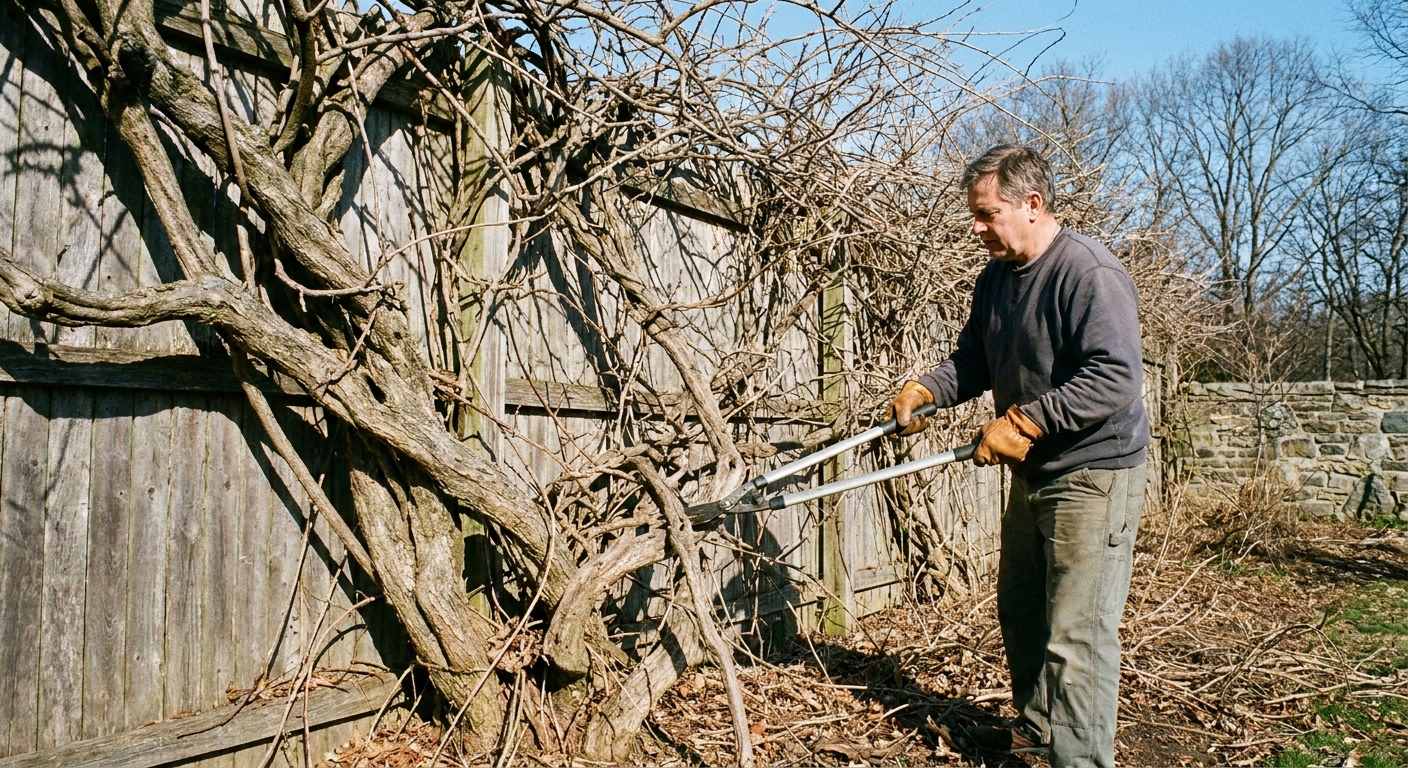
- Loppers: for thicker woody stems.
- Pruning saw: for old trunks and major renovation cuts.
- Gloves and long sleeves: wisteria tangles love to snag skin.
Wipe blades between plants, and especially if you cut out anything that looks diseased. Then rake up the trimmings. Those curly runners can re-tangle themselves into a tripping hazard faster than you would think.
Quick timing cheat sheet
- After flowering (mid to late summer): shorten new whippy shoots to 5 to 6 leaves.
- Late winter: shorten those same shoots to 2 to 3 buds.
- Any time: remove growth that is damaging structures, blocking paths, or heading somewhere unsafe.
If you do just those two trims consistently, wisteria usually rewards you with more flowers, a cleaner shape, and a whole lot less wrestling.