
Schefflera (Umbrella Plant) Care

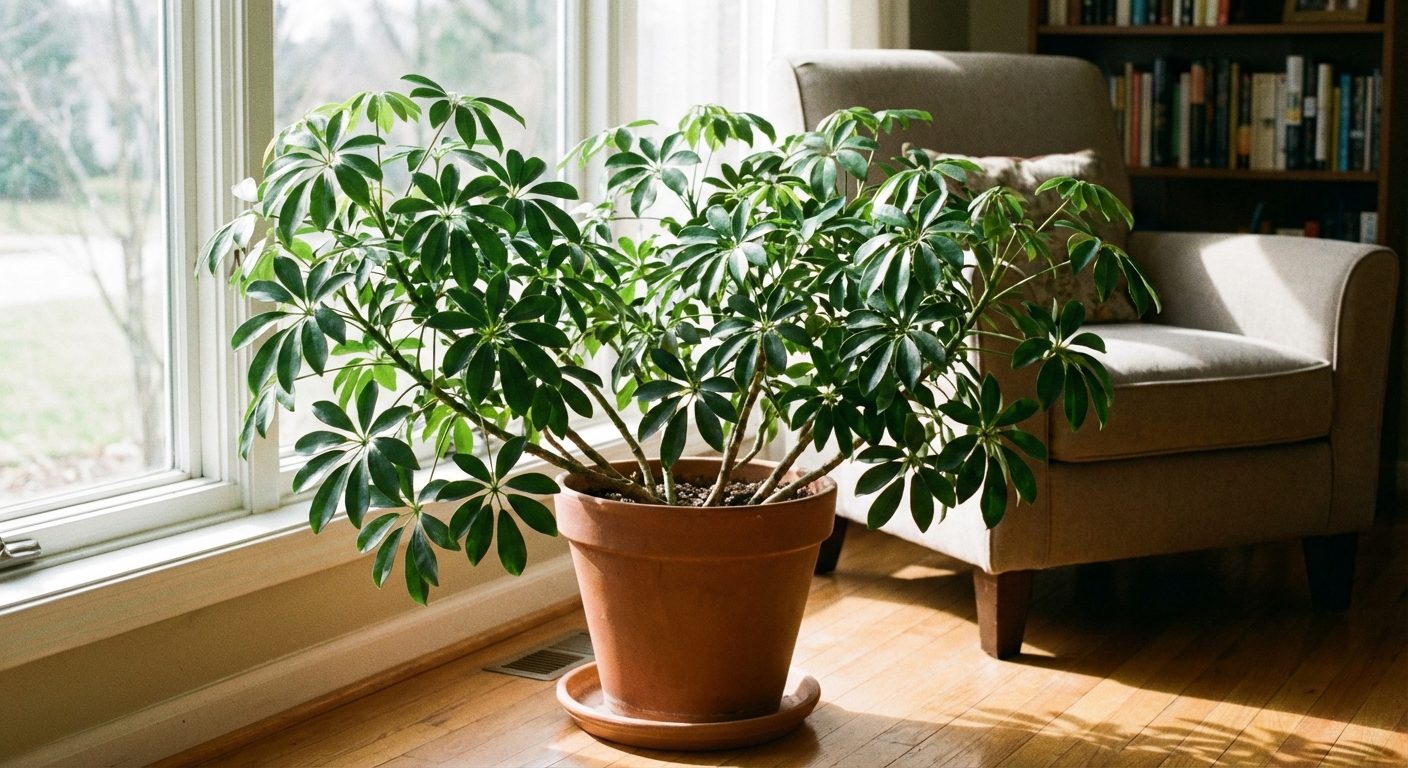
Schefflera, better known as the umbrella plant, is one of those houseplants that looks fancy but forgives beginners. It grows in leafy “spokes” like little green umbrellas, and with a few simple routines it can turn into a lush indoor mini tree.
I like schefflera because it teaches you the two big indoor plant truths: bright light solves a lot, and soggy soil causes most heartbreak. Let’s get you set up with a schefflera that grows steadily, stays full, and does not randomly rain leaves onto your floor.
Safety first: toxicity
Schefflera contains calcium oxalate crystals and is mildly toxic if chewed or swallowed by people, cats, and dogs. It can cause mouth irritation, drooling, and stomach upset. Keep it out of reach of pets and small kids, and wash your hands after pruning if you have sensitive skin.
Meet the two common types
Most “umbrella plants” sold as houseplants fall into two categories. Care is very similar, but their growth habits and sizing expectations are different.
Dwarf schefflera (Schefflera arboricola)
- Look: Smaller leaflets, often denser foliage. Frequently sold as a tabletop plant or trained as a braided “tree.”
- Growth: Usually tops out around 3 to 6 feet (0.9 to 1.8 m) indoors, depending on pot size and light.
- Great for: Apartments, desks, bright bathrooms, and anyone who wants a full plant without a huge footprint.
Full-size schefflera (Heptapleurum actinophyllum)
- Also labeled as: Often still sold as Schefflera actinophylla. Many tags have not caught up, so do not worry if yours uses the older name.
- Look: Larger leaves and longer petioles, more “tree-like” with time.
- Growth: Can reach 6 to 10+ feet (1.8 to 3+ m) indoors in ideal conditions. Needs more space and brighter light to look its best.
- Great for: Sunny living rooms, corners near large windows, and anyone who wants a statement floor plant.
Variegated schefflera tip: If your plant has creamy or yellow variegation, it needs brighter light than a solid-green one to stay colorful.
Braided “tree” note: Those trunks are usually multiple cuttings trained together. Good light and occasional tip-pruning help it stay leafy all the way down instead of turning into a pom-pom on sticks.
Light: the secret to a full, sturdy plant
If schefflera care had one “make it easy” lever, it would be light. Most problems beginners see, especially leggy growth and leaf drop, trace back to lighting and watering mismatches.
Best indoor light
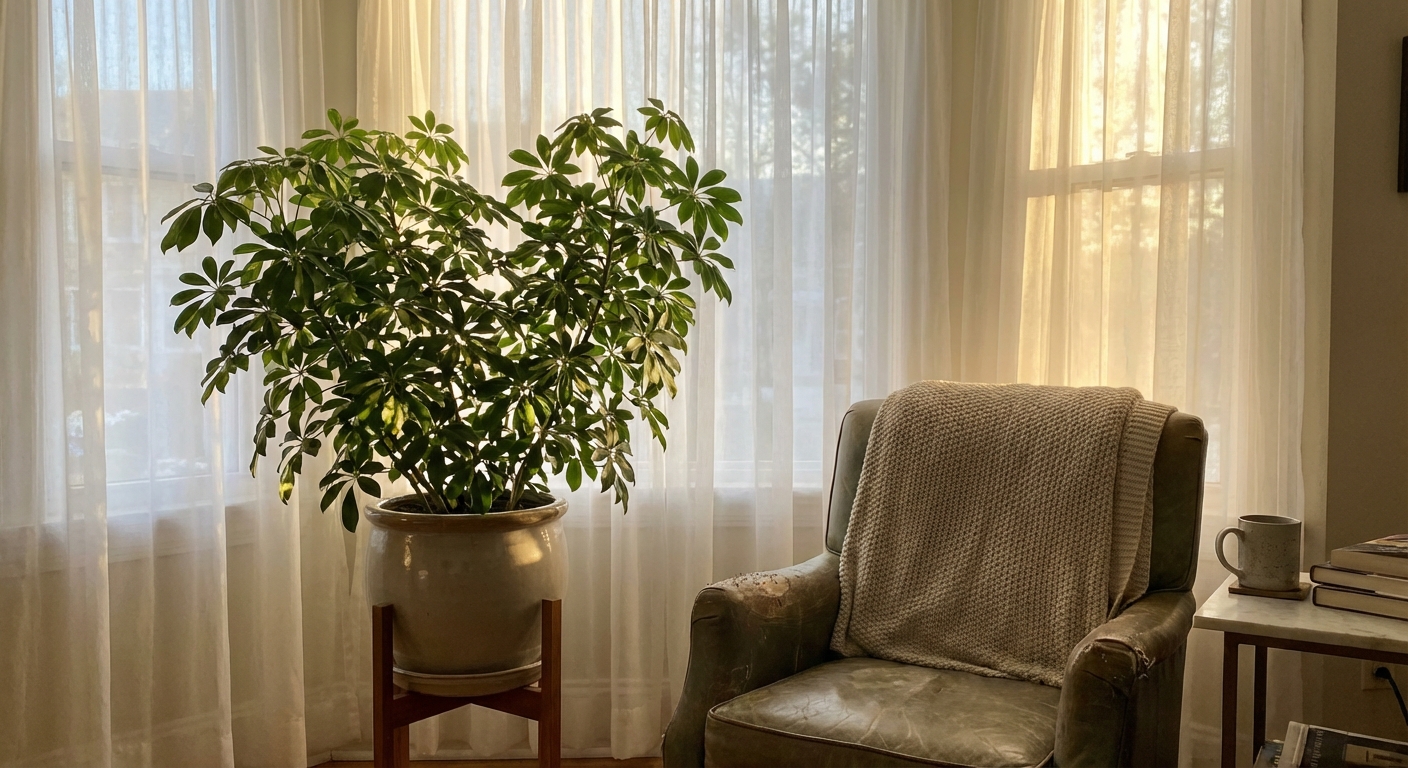
- Ideal: Bright, indirect light for most of the day.
- Can handle: A few hours of gentle direct sun, especially morning sun from an east window.
- About south or west windows: They can work, but hot afternoon sun can scorch leaves. Use a bit of distance, sheer curtains, or acclimate gradually if you are moving your plant into stronger light.
How to place it
- Near a bright window: 2 to 6 feet (60 to 180 cm) back is a common sweet spot. Closer is usually better if the plant is getting leggy.
- Rotate weekly: A quarter turn keeps it growing evenly instead of leaning.
- In low light: Expect slower growth and a thinner shape. If you cannot improve light, plan to prune regularly or consider a grow light.
Watering: how often, and how to get it right
Schefflera likes a rhythm: water thoroughly, then let part of the pot dry. It does not want to sit in constantly wet soil, and it does not want bone-dry conditions for long stretches either.
Beginner watering rule
Water when the top 2 inches (5 cm) of soil feel dry (about a finger’s depth for smaller pots, or two knuckles for larger ones). Then water until it drains from the bottom.
Typical frequency
- Spring and summer: Often every 7 to 12 days indoors.
- Fall and winter: Often every 10 to 21 days as growth slows and light is weaker.
Those numbers are a starting point, not a commandment. Light, pot size, humidity, and soil mix change everything. Small pots, terracotta, high light, and warm rooms often mean more frequent watering. Big pots, low light, and cool rooms often mean less. Your finger test is more trustworthy than the calendar.
How to water (my no-drama method)
- Carry the pot to a sink or tub, or place it on a deep saucer.
- Water slowly until you see steady drainage from the bottom holes.
- Let it drip for a few minutes.
- Empty the saucer. Do not let the pot sit in standing water.
Signs you are watering wrong
- Too much water: Yellowing leaves, soft stems, musty soil smell, sudden leaf drop, fungus gnats.
- Too little water: Leaves droop and feel papery, crispy brown edges, lots of leaves dropping after the plant has been dry for a while.
Soil and pot: set the roots up for success
Schefflera is happiest in an airy, fast-draining mix that still holds a bit of moisture. Think “fluffy cake,” not “wet brick.”
Simple soil mix options
- Easy option: Quality indoor potting mix plus extra perlite (about 20 to 30% perlite by volume).
- Chunkier option: Potting mix + perlite + orchid bark for more airflow, especially if you tend to overwater.
Pot must-haves
- Drainage holes: Non-negotiable.
- Pot size: Slightly snug is fine. A pot that is too large stays wet too long.
Repotting timing
Repot every 2 to 3 years, or when roots circle the bottom and watering becomes tricky (soil dries too fast or stays wet too long). Spring is ideal. Size up just 1 to 2 inches (2.5 to 5 cm) wider than the current pot.
Temperature and humidity
Schefflera is comfortable in the same temperatures most humans like, which is part of its charm.
- Temperature: Aim for 65 to 80°F (18 to 27°C). Avoid cold drafts and heat vents.
- Minimum: Try not to let it dip below about 55°F (13°C).
- Humidity: Average home humidity is usually fine. If your air is very dry, a small humidifier nearby can reduce crispy edges.
Fertilizer: less than you think
For beginners, the goal is steady growth, not rocket fuel.
- When: Feed in spring and summer, when the plant is actively growing.
- What: A balanced liquid houseplant fertilizer.
- How: Use half strength every 4 weeks, or full strength every 6 to 8 weeks.
- Skip feeding: In fall and winter, unless your plant is under a strong grow light and actively pushing new leaves.
If leaf tips brown and you know watering is solid, flush the pot with plain water every few months to wash out excess salts.
Pruning for bushier growth
Schefflera responds beautifully to pruning. If yours is tall and sparse, do not be afraid. A snip in the right place tells the plant to branch, and branching is what makes that lush, full look.
When to prune
- Best: Spring through early summer.
- OK: Any time if you are removing damaged or unhealthy growth.
How to prune to encourage branching
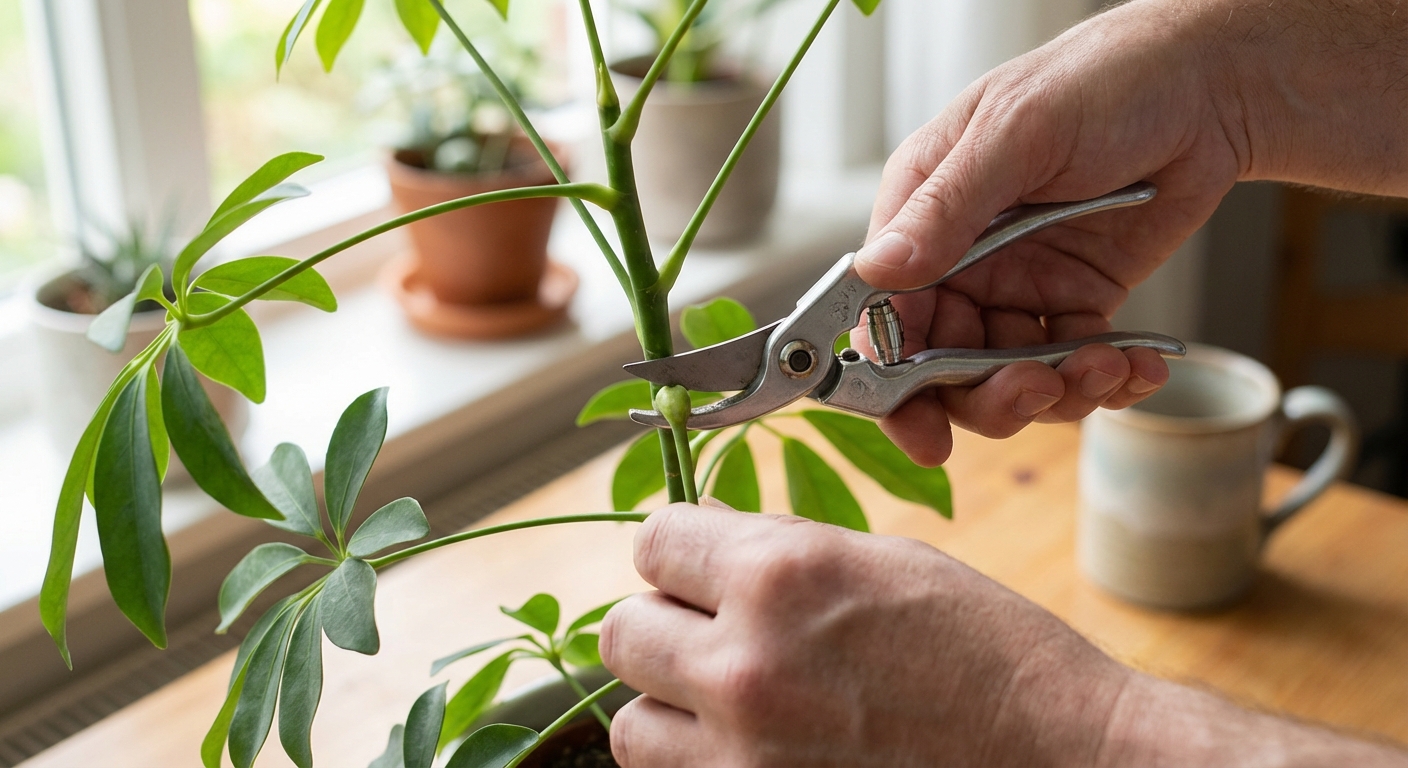
- Find a tall stem you want to shorten.
- Locate a node (where a leaf meets the stem).
- Cut just above a node using clean, sharp pruners.
- Repeat on a few stems rather than taking everything down at once.
My gentle rule: Do not remove more than about one-third of the plant at a time. You want it energized, not shocked.
Pinching for dwarf schefflera
On Schefflera arboricola, you can pinch off the newest tip growth with your fingers to encourage multiple shoots, especially when the plant is young and pliable.
Propagation from cuttings
Schefflera is one of those plants that makes you feel like a magician. You prune, you root the cuttings, and suddenly you have new plants for free.
Best time to propagate
Late spring through summer, when the plant is actively growing and daylight is long.
How to propagate in water
Water propagation works, but schefflera can be slower and a little less reliable in water than some other houseplants. Be patient.
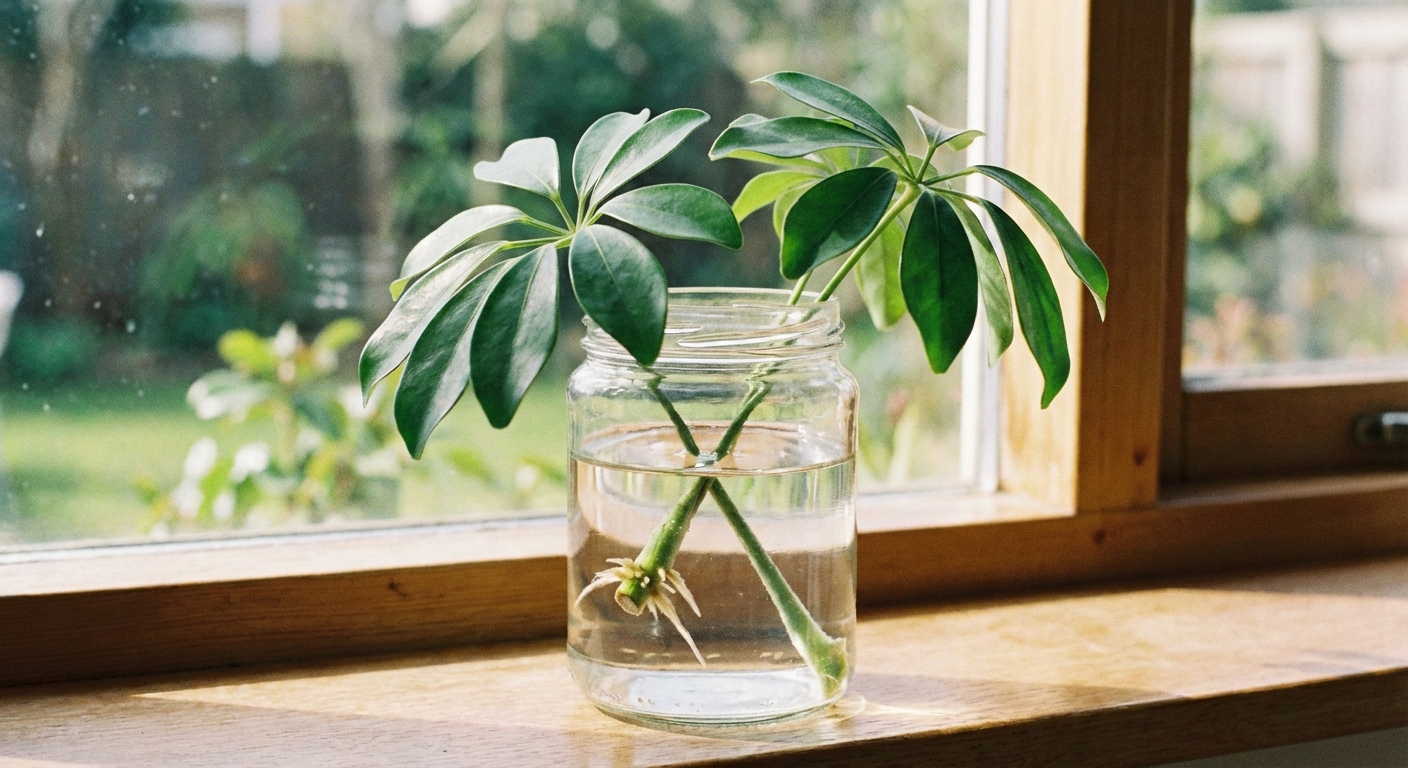
- Take a 4 to 6 inch (10 to 15 cm) cutting from a healthy stem, with at least 2 to 3 leaf clusters.
- Remove the lower leaves so no foliage sits underwater.
- Place the cutting in a jar of room-temperature water.
- Put it in bright, indirect light.
- Change the water every 5 to 7 days.
- When roots are 2 to 3 inches (5 to 7.5 cm) long, pot it up in a small pot with well-draining mix.
How to propagate in soil
Soil propagation is often sturdier long-term because the cutting never has to switch root types.
- Take a 4 to 6 inch (10 to 15 cm) cutting and remove lower leaves.
- (Optional) Dip the cut end in rooting hormone.
- Plant in a small pot of lightly moist, airy mix.
- Cover loosely with a clear bag to hold humidity, leaving a little airflow.
- Keep warm and in bright, indirect light.
- Check weekly. Roots often form in 4 to 8 weeks, sometimes longer.
Tip: Warmth helps. A consistently warm room or a seedling heat mat speeds rooting.
Common problems and how to fix them
Schefflera will communicate with you. Usually through leaves. Here are the most common beginner issues and the quickest, kindest fixes.
Leaves dropping
A little leaf shed now and then is normal, especially older leaves. A sudden “leaf rain” is your cue to investigate.
- Most common cause: Overwatering or soil staying wet too long.
- Also common: A big change in environment (new home, new window, seasonal light drop), cold drafts, or underwatering followed by a heavy soak.
What to do:
- Check soil moisture 2 inches (5 cm) down. If it is wet for days, pause watering and improve drainage and light.
- Move the plant away from drafty doors or blasting vents.
- Make sure the pot drains freely and the saucer is emptied.
- If roots are suspected to be rotting (sour smell, mushy stems), unpot and inspect. Trim mushy roots, repot into fresh airy mix, and water lightly.
Leggy growth
- Cause: Not enough light, plus the plant stretching toward a window.
- Fix: Move closer to brighter light, rotate weekly, and prune stems back to encourage branching. Consider a grow light in winter.
Yellow leaves
- Often: Overwatering.
- Sometimes: Natural aging (a few older leaves yellowing at the bottom).
If many leaves are yellowing quickly, treat it as a watering and drainage problem first.
Brown, crispy tips or edges
- Often: Underwatering, low humidity, or fertilizer salts building up.
- Fix: Water more consistently, consider a humidifier, and flush the soil occasionally with plain water.
Sticky leaves or bumps
Sticky residue (honeydew) and tiny bumps usually point to sap-sucking pests like scale, mealybugs, or aphids.
- Quick ID: Scale often looks like brown, tan, or shiny little “shells” stuck to stems. Mealybugs look like small bits of cotton tucked into leaf joints.
- What to do: Isolate the plant, wipe leaves and stems with a damp cloth, then treat with insecticidal soap or horticultural oil, repeating weekly for a few rounds. Check undersides of leaves and along stems.
Fine webbing or speckled leaves
This is more typical of spider mites, especially in dry air. Rinse the plant in the shower, wipe leaf undersides, and treat with insecticidal soap, repeating as needed.
Quick care checklist
- Light: Bright, indirect. Some morning sun is great. Strong afternoon sun can work with distance or filtering.
- Water: When top 2 inches (5 cm) are dry, then water thoroughly and drain.
- Soil: Airy, fast-draining mix in a pot with drainage holes.
- Prune: In spring and summer to encourage branching and a bushier shape.
- Propagate: Stem cuttings in water or soil, best in warm bright months.
- Clean: Wipe dusty leaves occasionally so it can photosynthesize properly and so pests are easier to spot.
- Watch for: Leaf drop after changes, legginess in low light, and pests on undersides and stems.
If you take nothing else with you, take this: give your schefflera brighter light than you think it needs, and let the soil dry a bit between waterings. It will reward you with that calm, leafy “I have my life together” energy that every room deserves.