Orchid Spike or Root? How to Tell

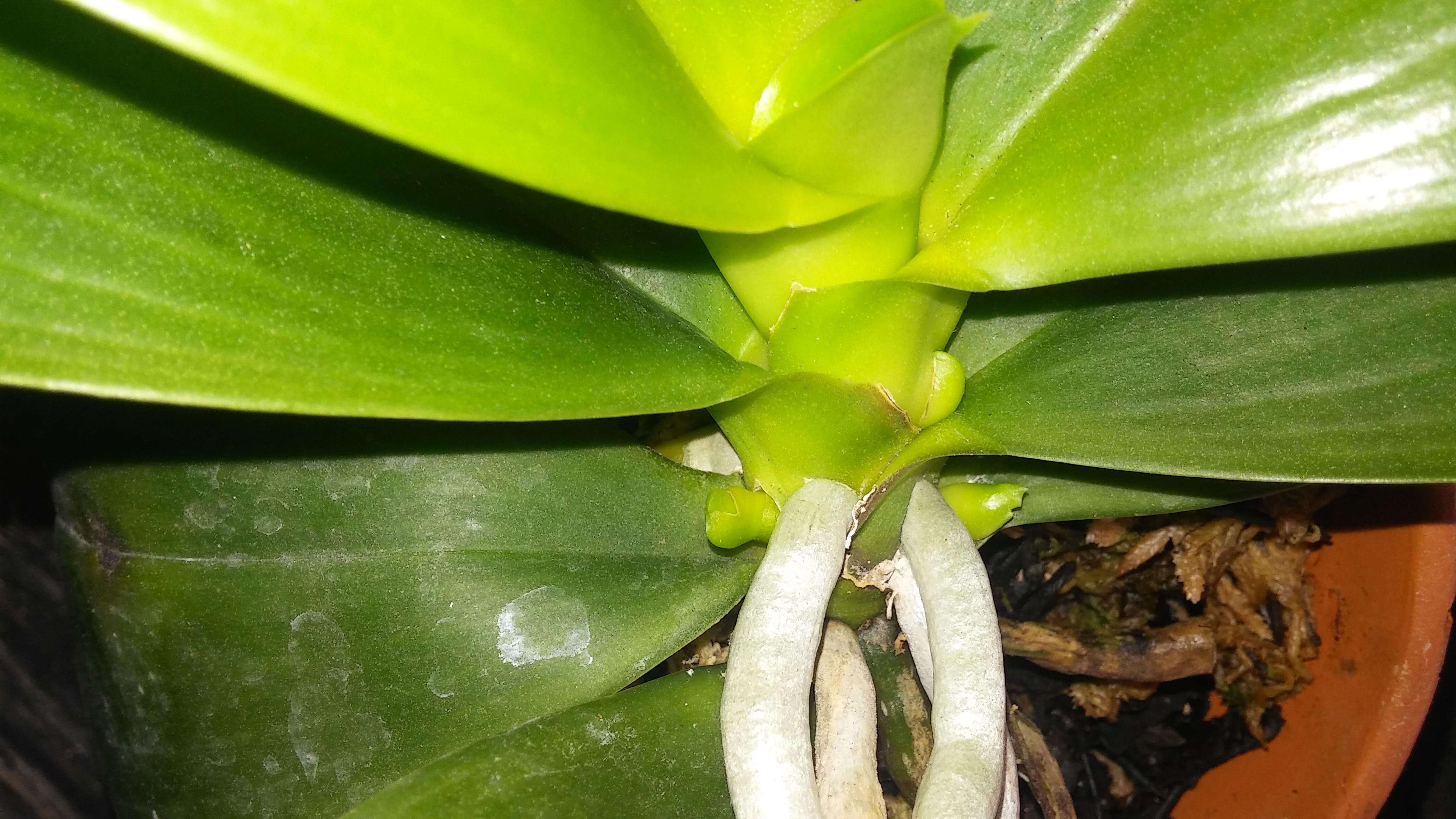
The day you notice a tiny green nub on your Phalaenopsis orchid is the day your brain turns into a detective board. Spike? Root? Surprise baby? I have absolutely hovered over new growth with my morning coffee like it was a breaking news event.
The good news is you usually do not have to wait weeks to know. With Phalaenopsis, you can often tell by three clues: tip shape (hello, “mitten tip”), where the growth emerges, and the direction it wants to go.

The fast answer: 3 clues that usually settle it
- Tip shape: spikes often have a little “mitten” or beak-like tip, while roots have a smooth, rounded bullet tip.
- Where it comes from: spikes typically emerge from the stem between leaves, not from deep in the potting mix. (If your orchid is planted deep, a spike can look like it is coming from the mix when it is really coming from the buried stem.) Roots can emerge from the stem too, but they often start lower and push out from wherever the plant feels like anchoring.
- How it grows: spikes often reach toward light over time and tend to grow more “up and out,” though they can start sideways while squeezing between leaves. Roots wander, dive, and curve, and they often head down toward the pot or sideways along the surface.
Meet the “mitten tip”
If you only remember one thing, make it this: early flower spikes often look like a tiny mitten. Orchid folks call it the mitten tip because the tip is slightly flattened with a little notch or point, like a mitten thumb forming.
What a spike tip looks like
- Flattened or slightly angular tip
- Often a tiny notch, beak, or “duck bill” look
- The surface can look a bit segmented as it elongates, like it has little joints
What a root tip looks like
- Rounded, smooth “bullet” tip
- Often shiny
- Usually shows a distinct green, yellow-green, or pinkish growing point (the fresh root tip) with a more silvery or pale section behind it as velamen develops
One caution from someone who talks to her ferns: brand-new growth can be ambiguous for a while, especially in lower light or cooler conditions. If you are not sure, do not pick at it. Let it grow to the length of your pinky nail (roughly 1 to 2 cm, about 1/2 inch) and check again.
Where it emerges: the best map on your orchid
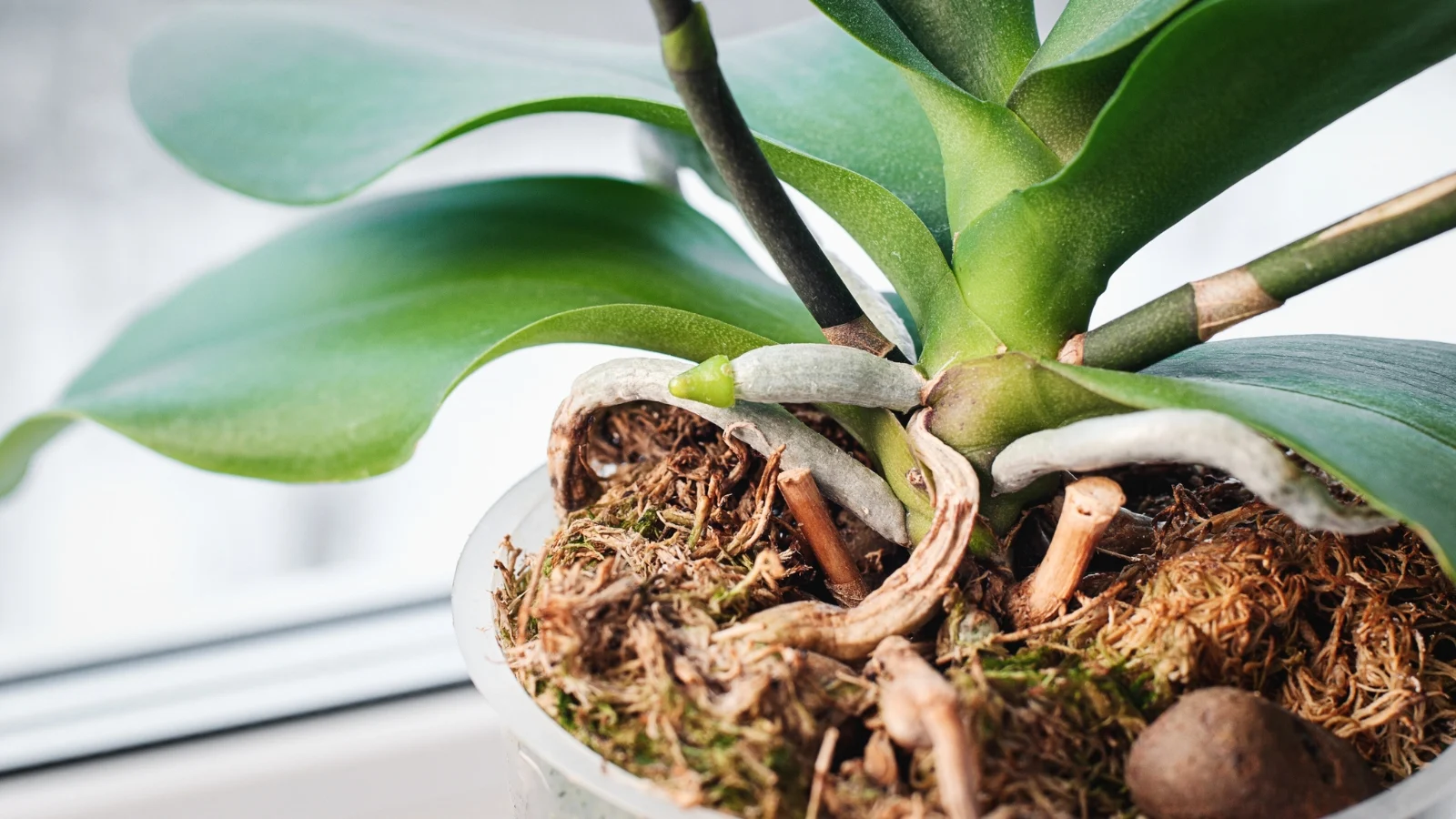
Phalaenopsis orchids grow in layers. Leaves stack from the crown, and growth points appear along the stem between those leaves.
Flower spike emergence points
A spike most often emerges from the side of the stem, tucked between leaves, usually closer to the base than the newest leaf but not from the crown itself. You will see a nub pushing out from the “armpit” area where a leaf meets the stem.
- Usually between leaves, slightly above or level with older leaves
- Often appears as a small, firm, pointed nub
- Commonly starts on one side of the plant and then angles outward
Root emergence points
Roots can emerge from many points along the stem, including between leaves, from lower stem sections, and even from spots that look inconveniently random. Aerial roots often start higher than you expect.
- Can start low near the potting media or higher up
- Often pushes out with a rounded tip and quickly shows that smooth, wandering root behavior
- May flatten a little if it presses against a pot rim, but the tip stays rounded
Which direction it grows: spikes reach, roots roam
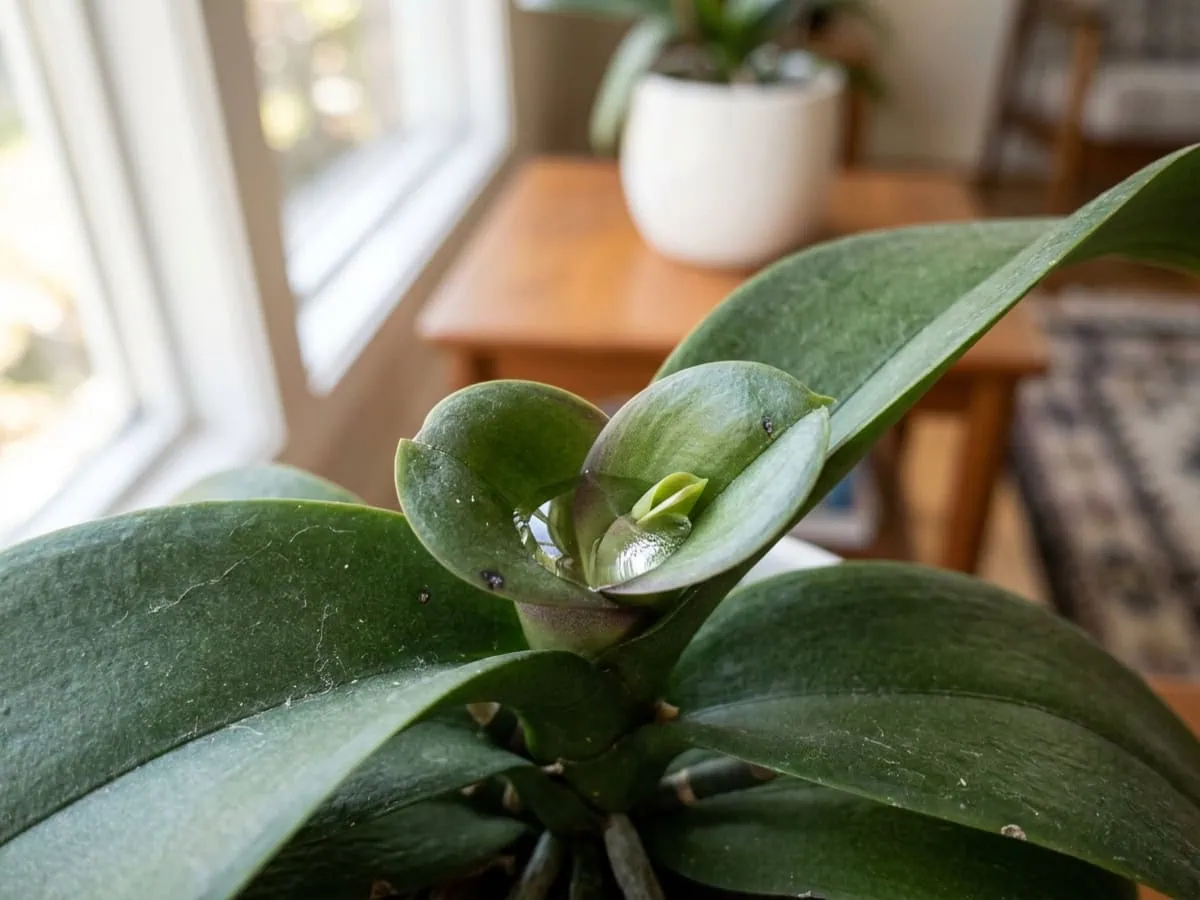
Once the growth is about 1 to 2 inches long, direction becomes a big tell. In slower conditions, it may take longer to get to that “obvious” stage.
Typical spike growth direction
- Upward and outward over time, often aiming toward the brightest area
- More rigid compared to roots
- Tends to keep a consistent direction for stretches, then slowly re-aims toward light
Typical root growth direction
- Down, sideways, or looping wherever humidity and surfaces feel right
- Flexible and exploratory
- Often hugs the pot, crawls along bark, or dives toward the mix
If you rotate your orchid, spikes may gradually follow the new light source over time. Roots generally do not “track” light in the same purposeful way.
What about a keiki?
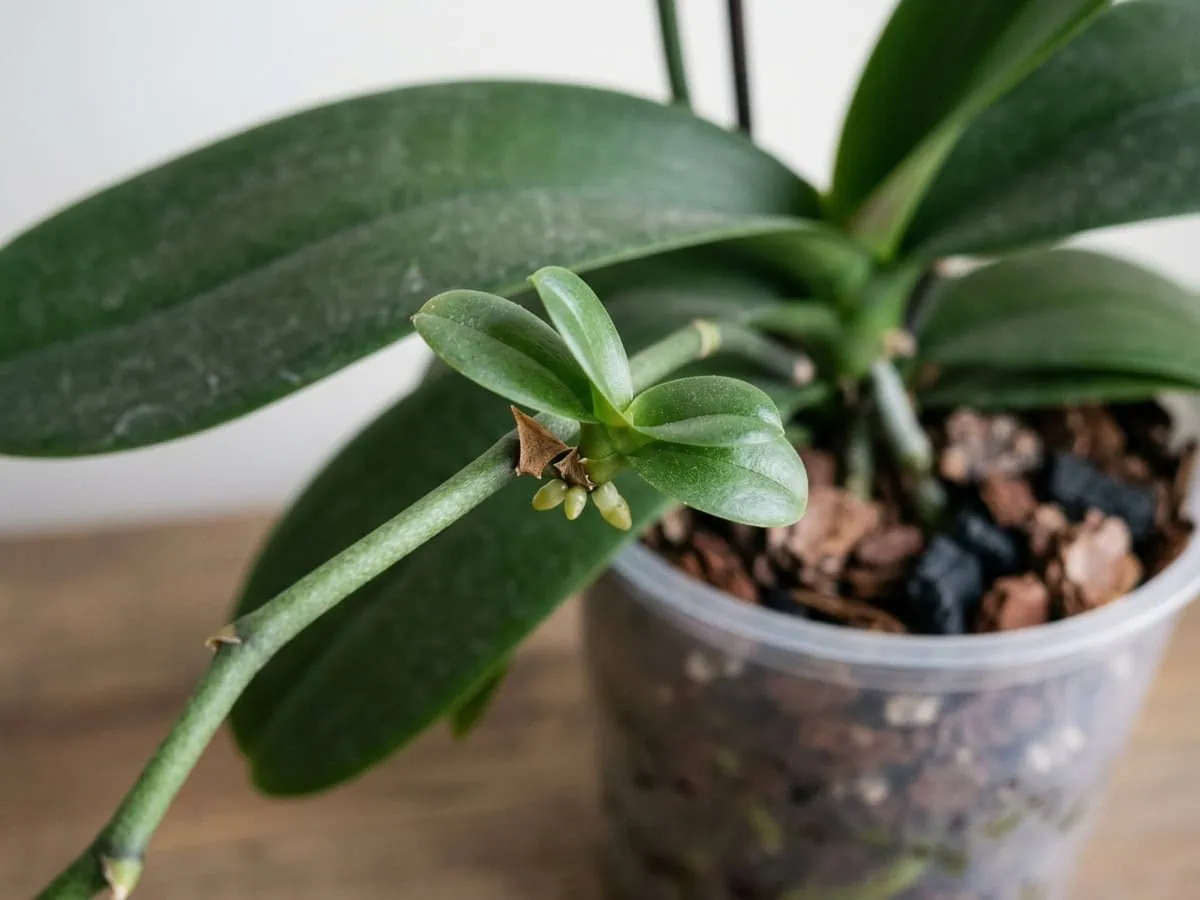
A keiki is a baby orchid plantlet that can form on a flower spike or sometimes from the stem area. Early on, keikis can confuse people because they start as a little green bump too.
Keiki clues
- Instead of a single pointed tip, you will eventually see tiny leaf nubs forming a miniature crown
- Keikis often develop two little leaves fairly quickly once they commit to being a plantlet
- They most commonly appear on an existing flower spike, at a node where a bract was
- Basal keikis (from near the base) can happen on older or stressed plants, but they can also show up on otherwise healthy orchids
If the bump is on a bare section of flower spike and you start seeing leaflets rather than a long, tapered structure, you are likely looking at a keiki in the making.
Leaf or something else?
Sometimes the “mystery nub” is just a new leaf. A new leaf emerges from the crown (the center) and looks like a flatter, smoother spear that slowly unfurls into a full leaf. If the growth is coming straight out of the center where your newest leaf appeared last, treat it like crown growth: be gentle, and do not let water sit in there.
A simple checklist you can use in 30 seconds
- Is the tip rounded and glossy? Likely a root.
- Is the tip flattened with a little notch, like a mitten? Likely a spike.
- Is it coming off an old flower spike node and forming tiny leaves? Likely a keiki.
- Is it growing up and gradually aiming toward the window? That supports spike.
- Is it wandering, looping, or diving? That supports root.
When in doubt, give it time. Sometimes it is obvious in a week, and sometimes it takes a bit longer. Your orchid will not be offended by your cautious optimism. Mine never are, even when I narrate their progress out loud.
Common mix-ups
“My root has a pointy end. Does that mean it is a spike?”
Root tips can look surprisingly sharp when they are tiny. The difference is texture and shape. A spike tip looks more flattened and structured. A root tip looks smooth, rounded, and a bit like a pencil eraser in miniature.
“The growth is purple or reddish. What is it?”
Both spikes and roots can show red or purple tones, especially in bright light or on orchids with pigmented blooms. Use shape and emergence point more than color.
“It is growing sideways. Can a spike do that?”
Yes. Spikes often start sideways because they are squeezing out from between leaves, then they arc toward light as they lengthen. If it still has that mitten tip and a more rigid feel, it can absolutely be a spike.
“Can spikes come from the crown?”
Phalaenopsis spikes usually do not come from the crown. If you see growth emerging from the center where new leaves come from, it is more likely a new leaf. Treat crown growth gently and avoid water sitting there.
Hands-off care while you wait
Until you are sure what it is, the best move is boring but effective.
- Do not peel or pry at the little protective bract tissue near the base.
- Keep light steady, bright and indirect.
- Water normally, letting the potting mix approach dryness before watering again.
- Avoid repotting if the plant is stable. New growth is a sign the orchid is in motion, and big changes can stall it.
If you confirm it is a spike, two extra things help: do not stake it too early (let it get some length and flexibility first), and try not to rotate the pot constantly if you want a straighter spike.
If you want a tiny action step right now, wipe dust from the leaves with a damp cloth so the plant can photosynthesize like a champ. Then let that new growth declare itself.
Quick FAQ
How long until I know for sure?
Often within 7 to 14 days, but it can take longer in low light or cooler conditions. Once it reaches about 1 to 2 inches, the identity is usually obvious.
Do roots mean my orchid will not bloom?
Not at all. Roots can show up anytime, and strong root growth often supports better blooming later.
Can I accidentally damage a spike by touching it?
Gentle touching usually will not hurt, but squeezing, bending, or scraping can. If you are unsure, look closely rather than handling it.
Is there a seasonal clue for spikes?
Sometimes. Many Phalaenopsis are more likely to initiate spikes after a stretch of slightly cooler nights, but it is a supporting hint, not a rule.