
Mealybugs on Orchids

Mealybugs have a special talent for showing up exactly when your orchid is feeling its most glamorous. One week you have pristine blooms, the next you notice little cottony tufts tucked into a leaf joint, and suddenly you are spiraling into plant-parent guilt.
Deep breath. Orchids are tougher than they look, but their tissues are thin and their roots are sensitive, so the trick is gentle, targeted treatments repeated on a smart schedule. I will walk you through where to look, how to isolate, and how to treat without sacrificing flowers or frying tender roots.

How to tell it’s mealybugs (not just dust)
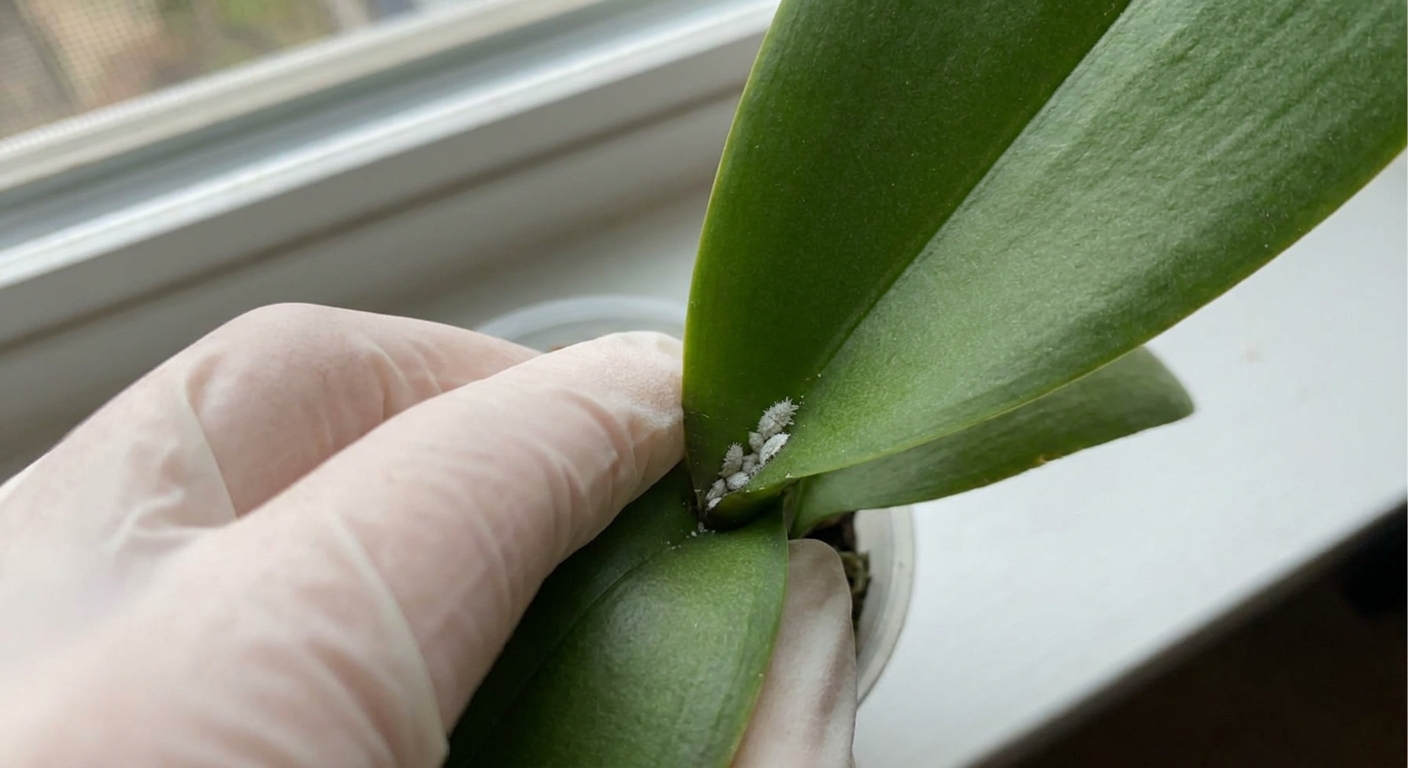
Mealybugs look like tiny bits of cotton or fuzz, often with a slightly ridged, oval body underneath. On orchids, they commonly appear as:
- White cottony clusters in tight crevices
- Sticky residue (honeydew) on leaves, stakes, or the pot
- Sooty mold, a dark film that grows on that sticky honeydew
- New growth that stalls or looks puckered and stressed
- Buds that yellow and drop for “no reason”
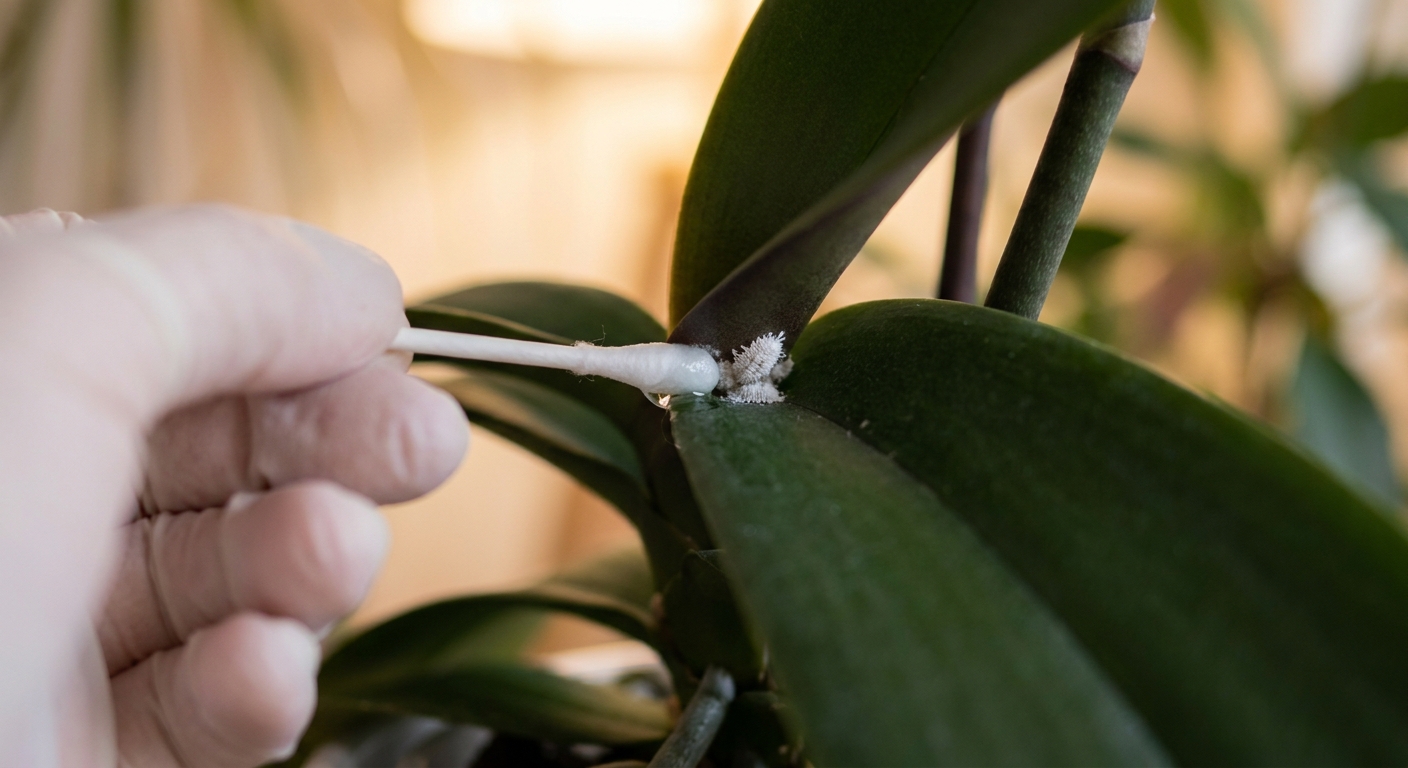
If you dab a suspicious tuft with a cotton swab, mealybugs smear a little and may reveal a soft-bodied insect underneath. Mineral deposits, by contrast, feel gritty and do not smear.
Where mealybugs hide on orchids
On many houseplants, mealybugs hang out on leaf undersides. Orchids are sneakier. These are the places I inspect first, every time:
Leaf axils and crown creases
Leaf axils are the tight joints where leaves meet the stem. On Phalaenopsis, this is mealybug real estate because it is sheltered and hard to rinse. Use a flashlight and gently spread the leaves with your fingers.
Quick crown reminder: Try not to let liquids pool in the crown or leaf joints. If anything collects, blot it dry with tissue.
Flower spikes and bud nodes
Check where side branches emerge and around the tiny “knuckles” on the spike. Mealybugs love to sit close to sap flow, and spikes provide plenty.
Under papery sheaths on canes
On Dendrobiums and some Oncidiums, dried sheaths can hide a whole little colony. If the sheath peels away easily, lift it and look underneath. If a sheath is loose and heavily infested, you can gently remove it to expose hiding spots. Do not force anything that is green and firmly attached.
Roots at the pot edge
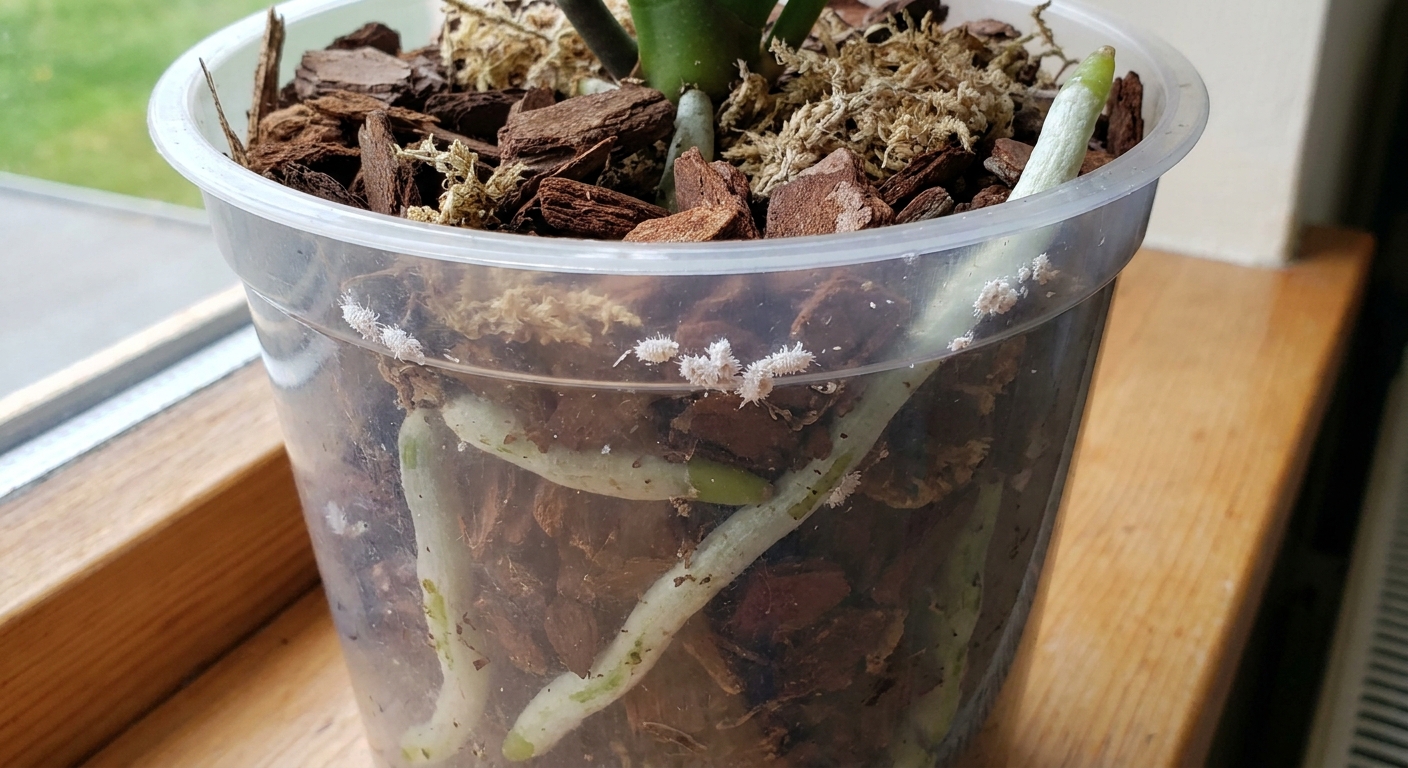
This is a big one. Mealybugs often congregate where roots meet air, especially along the inside rim of a clear pot.
Down in the media (root mealybugs)
Sometimes the insects are mostly in the potting mix or bark, feeding on roots. Signs include unexplained dehydration even when you water properly, and white cottony clusters down near the base.
Isolate and treat: a calm workflow
Orchids do best when you follow a repeatable routine instead of throwing every remedy at them in one day. Here is my gentle workflow.
Step 1: Isolate immediately
Move the orchid away from your other plants. Mealybugs crawl, but they also hitchhike on sleeves, watering cans, and shared humidity trays. Give your orchid its own little quarantine corner for at least 4 weeks.
Step 2: Protect blooms
If your orchid is in bloom, you can absolutely treat it, but be mindful:
- Avoid saturating blooms with sprays. Petals spot easily.
- When possible, swab instead of misting near flowers.
Step 3: Do a slow, thorough inspection
Use a bright light. I like to set the plant on a towel at a table and rotate it like I am giving it a spa consultation. Look in every crease, especially the leaf axils and the pot edge.
Step 4: Start with physical removal
This is the least stressful for orchids and often the most effective when the infestation is small.
- Dip a cotton swab in 70% isopropyl alcohol and touch each mealybug directly.
- Wipe sticky residue off leaves with a damp cloth afterward.
- Use a toothpick wrapped with a tiny bit of cotton for tight creases.
Note: Alcohol is a spot treatment, not a full bath. Avoid drenching the crown, soaking aerial roots, or repeatedly flooding the same patch of tissue. If you have a sensitive orchid (or you are unsure), test one small area first and check for spotting the next day.
Gentle treatment options
Think of this as a ladder. Start as gently as you can, then step up only if mealybugs keep returning.
Option 1: Manual removal plus a rinse
After swabbing visible bugs, you can rinse the plant to flush hidden crawlers.
- Use lukewarm water and a gentle stream.
- Angle the plant so water runs out of leaf joints, not into them.
- Let it drain completely.
This works best for sturdy, well-rooted orchids. If roots are already stressed or rotting, skip heavy rinsing and focus on swabbing and repotting.
Option 2: Insecticidal soap (with orchid cautions)
Insecticidal soap can help, but orchids are not like pothos. Their leaves can be thin, and their roots can be sensitive.
- Choose a ready-to-use insecticidal soap labeled for indoor ornamentals or houseplants.
- Dish soap is not the same thing. Even “gentle” dish soap can damage leaves and roots.
- Test on a small area of one leaf first. Wait 24 hours to check for spotting.
- Apply in the evening or out of direct sun to reduce burn risk.
- Keep spray light on blooms. Better to spray a cloth and wipe leaves than to mist petals.
Important: Never mix soap with other products, and do not exceed label rates. More is not better with orchids.
Option 3: Horticultural oil or neem (use sparingly)
Oils can be effective because they smother pests, but they can also leave a film that may reduce gas exchange and increase burn risk, especially if applied heavily or in bright light. If you use oil:
- Use a very light application and target crevices, pot edges, and the underside of leaves.
- Avoid spraying the crown heavily.
- Do not apply in heat or bright sun.
- Keep oil off blooms when possible. Petals can spot and drop.
If your orchid is already dehydrated, sun-stressed, or freshly repotted, I usually skip oils and stick to swabbing plus follow-up checks.
Option 4: Repotting (best for pot and media infestations)
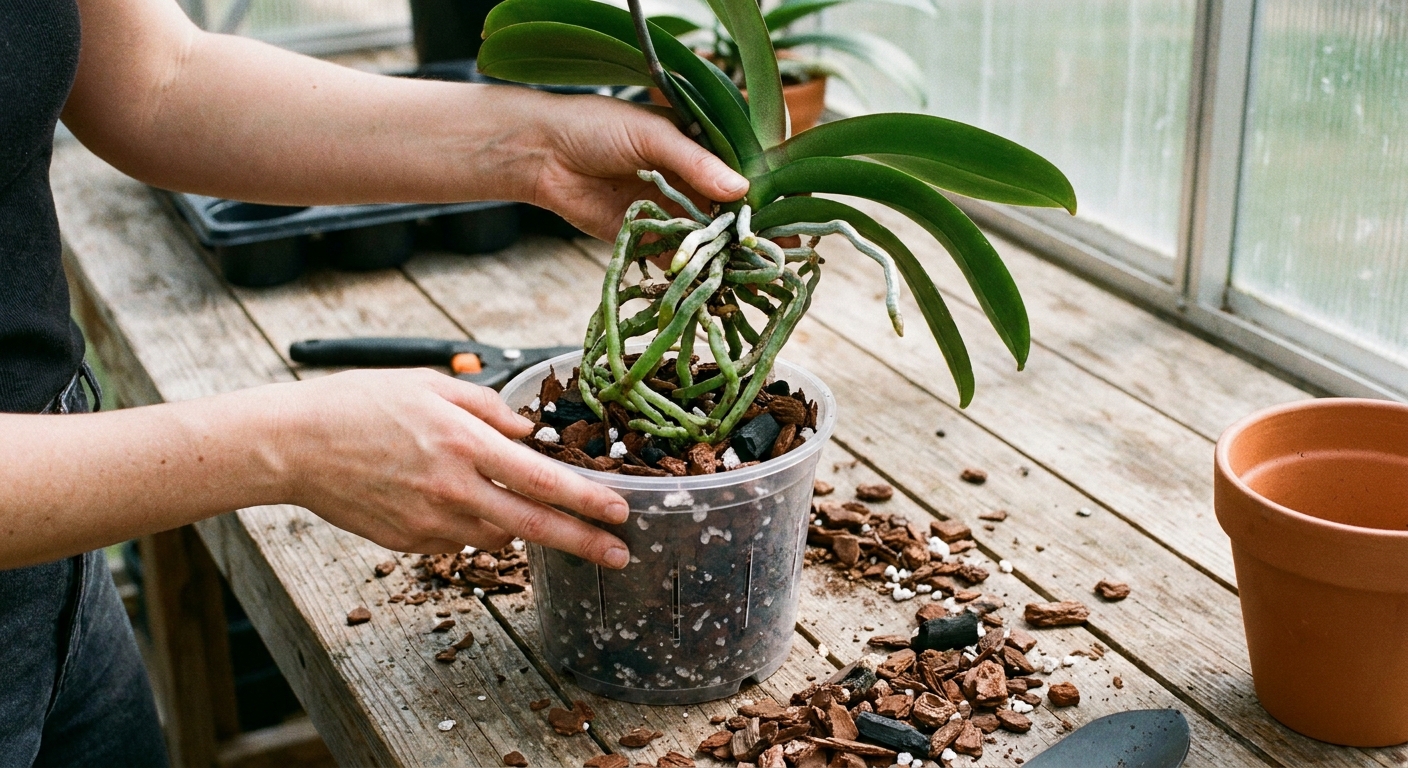
If you see mealybugs down at the pot edge, in the media, or on roots, repotting often shortens the battle dramatically.
- Remove the orchid from the pot and gently shake away old media.
- Rinse roots with lukewarm water.
- Snip dead, mushy roots with sterilized scissors.
- Wash the pot with hot soapy water, then rinse well. If it is heavily infested or hard to clean, replace it.
- Replace old stakes and clips if they are sticky or hard to scrub clean.
- Repot into fresh orchid bark or your preferred orchid mix.
After repotting, hold off on fertilizing for a couple of weeks. Let the roots settle and heal.
Follow-up timing
Mealybugs have life stages, and the tiny “crawler” stage is what you are trying to catch between treatments. One cleaning is rarely enough.
A simple repeat schedule
- Day 1: Isolate, inspect, swab visible bugs, and do your chosen treatment.
- Day 7: Re-inspect leaf axils, spike nodes, and pot rim. Repeat swabbing and treatment.
- Day 14: Repeat again.
- Day 21 to 28: One more check and touch-up treatment if you see any signs.
If you are using insecticidal soap or oil, follow the product label for maximum frequency. When in doubt, gentler and repeated beats harsh and once.
What “all clear” looks like
Your orchid is likely in the clear when:
- No new cottony clusters appear for 4 weeks
- Leaves feel clean, not sticky
- New growth looks smooth and steady
Keep blooms and roots safe
Bloom-friendly tips
- When possible, swab instead of spraying near flowers.
- If you must spray, shield blooms with your hand or a paper towel and mist lightly.
- Do treatments when the plant is cool and out of sun.
Root-friendly tips
- Avoid saturating the pot with soaps or oils. Orchid roots need air as much as moisture.
- If you suspect root mealybugs, repot rather than repeatedly drenching the media.
- Do not fertilize heavily while treating pests. Salt buildup plus stress is a rough combo.
If your orchid is already struggling, focus on stability: bright indirect light, good airflow, and a normal watering routine. Stress makes orchids more attractive to pests, and recovery is part of prevention.
What not to use
When you are stressed, it is tempting to go full science experiment. Orchids prefer restraint. Skip these:
- Alcohol baths or high-concentration alcohol (90%+) on leaves and roots
- Household cleaners (bleach sprays, disinfectant sprays, glass cleaner)
- Random essential oil mixes
- Strong dish soap solutions used as a “pesticide”
If a product is not labeled for plants, do not put it on your orchid.
Common mistakes
- Mistake: Spraying the crown until it drips.
Instead: Swab crevices and blot any pooled liquid. - Mistake: Treating once and putting the orchid back with other plants.
Instead: Quarantine and re-check weekly for at least 4 weeks. - Mistake: Ignoring the pot edge and media.
Instead: Inspect the rim and repot if you see cottony patches below.
Prevention that helps
Mealybugs often arrive on a new plant, or they take advantage of a stressed one. A few habits make a big difference:
- Quarantine new orchids for about 4 weeks before they join your collection.
- Inspect leaf axils every time you water. It takes 10 seconds with a flashlight.
- Keep leaves dust-free. A quick wipe helps you notice pests early.
- Avoid over-fertilizing. Very soft, nitrogen-heavy growth can attract sap feeders.
- Give good airflow around leaves and spikes, especially indoors.
- Watch for ants. Ants can “farm” honeydew pests and keep them protected. If you see ants, address them too.
- Clean the neighborhood. Wipe nearby shelves, windowsills, trays, and the outside of the pot to remove sticky honeydew and hitchhikers.
When to escalate
If you have repeated outbreaks despite careful follow-up, or you are seeing widespread root mealybugs, it may be time to:
- Repot into fresh media if you have not already
- Replace old pots, stakes, and clips
- Trim away badly infested dead sheaths or sacrifice a heavily infested spike if it is acting like a pest highway
- Consider a targeted systemic insecticide only if it is labeled for indoor ornamentals and permitted for your use case, and you can follow the label exactly
Systemics vary by country and region and may be restricted. If you go this route, keep treated plants away from pollinators, pets, and edible plants, and never exceed label rates. If you have a large collection and one plant stays chronically infested, it is also okay to discard it to protect everything else.
Home safety note
If you have kids or pets, store treatments locked away, let sprays dry fully before putting the orchid back in reach, and avoid applying anything in areas where curious noses can investigate wet leaves. When in doubt, stick with careful swabbing, repotting, and quarantine.
A gentle closing pep talk
Mealybugs are not a moral failing, and they do not mean you are “bad at orchids.” They mean you have a living plant in a living home, and sometimes tiny freeloaders try to move in.
Start with careful inspection, isolate, swab what you see, and repeat on schedule. Your blooms can stay, your roots can stay, and your orchid can absolutely bounce back.